


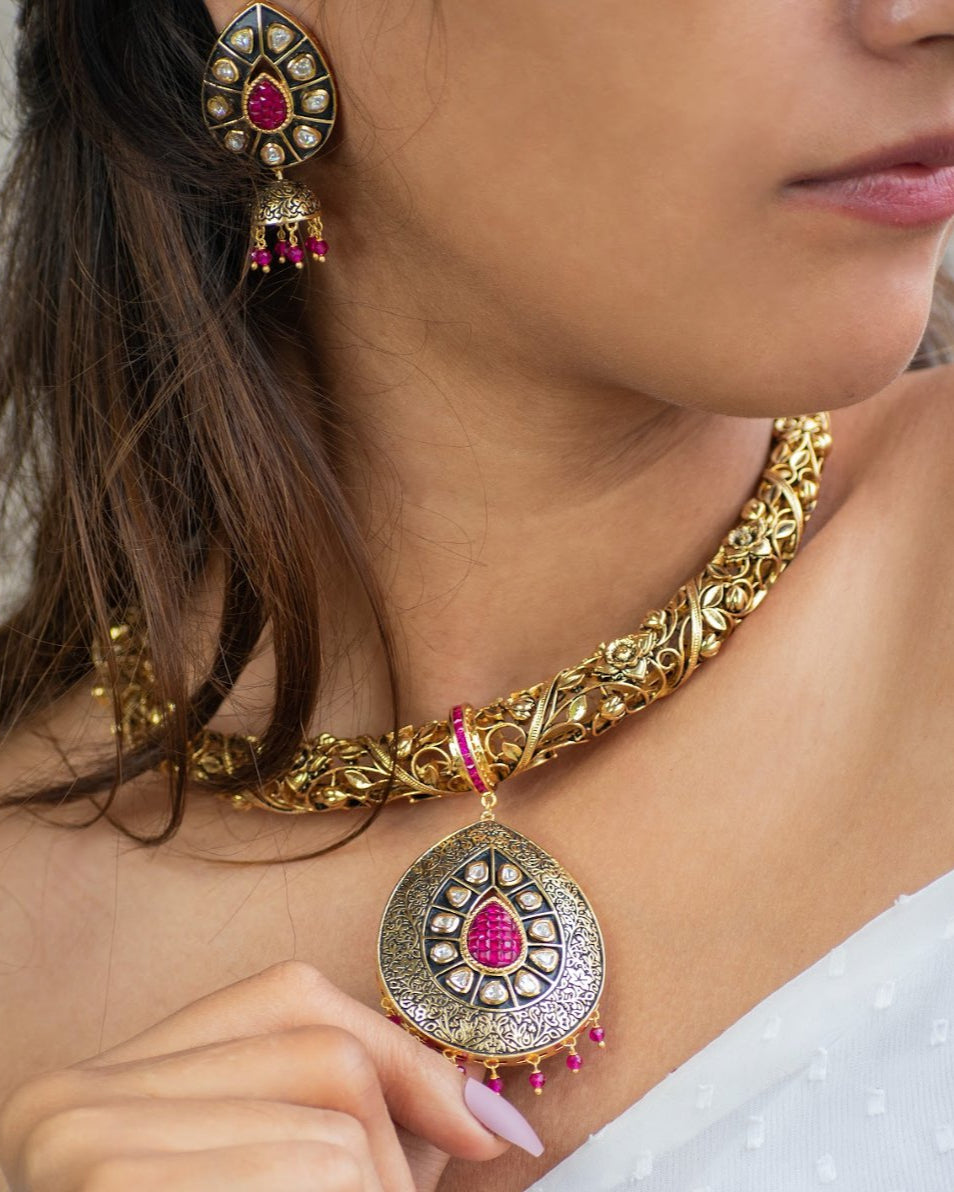


Of all the jewellery a woman wears, the necklace carries the most weight — literally and symbolically. It frames the face, anchors an outfit, and signals occasion more clearly than any other piece. A slim pendant at the collarbone speaks of quiet confidence; a wide polki gulbandh declares celebration before you've said a word.
Yet, for all the joy necklaces bring, choosing one can feel overwhelming. The vocabulary alone is enough to confuse — choker, princess, matinee, gulbandh, haram, layered set. Add to that the craft traditions of kundan, polki, meenakari, and temple jewellery, and the decision can seem impossibly complex. We hear this from customers every day.
This guide is your complete reference. We'll walk you through necklace lengths, the main styles, which occasions each suits, and — with picks from our collection at every step — help you build a necklace wardrobe that takes you from Monday morning to wedding morning with ease.
Understanding Necklace Lengths: Finding Your Fit
The single most overlooked factor when buying a necklace is length. A stunning piece can look wrong simply because it sits at the wrong point on your neckline. Before choosing a style, understand where each length falls — and which necklines and outfits it flatters.
The Main Necklace Styles — A Definitive Guide
Indian necklace styles span centuries of craft, from the jewel-set collars of Mughal courts to the temple motifs of South Indian heritage. Here are the four categories you'll encounter most — and exactly when to reach for each one.
The choker is the most architecturally bold of all necklace lengths. Sitting snugly at the base of the neck, it draws the eye upward, elongates the appearance of the face, and makes even a simple blouse look considered. In Indian jewellery, the choker has a rich lineage — from the regal haar of Rajput queens to the kundan-set collar necklaces favoured at court.
Today's chokers range from the delicately beaded to the heavily embellished. The Anvika Kundan Pearl Drop Choker Set layers kundan work with cascading pearl drops for a traditional yet graceful silhouette. For something with a richer, more contemporary collar feel, the Kaavya Luxe Pearl Collar Choker Set offers a wide pearl-edged collar that pairs beautifully with a simple saree blouse or a structured kurta. The Nayantara Jhumki Choker Set adds a playful dimension — the jhumki drops make it as much earring showcase as necklace statement.


If there is one necklace length every jewellery wardrobe should start with, it is the princess length. Falling just below the collarbone at 17–19 inches, it flatters every neckline and suits every occasion from a Tuesday at the office to a Saturday Diwali gathering. A well-chosen princess pendant is the necklace equivalent of a perfect white kurta — endlessly useful, quietly beautiful.
The Divine Harmony Ganesha Pendant Necklace is precisely this kind of piece — devotional, refined, and suited to daily wear without feeling costume-y. For a touch more ceremony, the Kairavi Antique Kundan Pendant Set carries the patina of heirloom jewellery in a compact, easy-to-wear format. Those who love colour will find the Maheera Floral Kundan Meenakari Pendant Set irresistible — the meenakari enamel work brings warmth and personality to even a simple cotton dupatta look. For fusion and contemporary wear, the Aarinya Sabya Pendant Set bridges traditional craft and modern styling with effortless grace.


The gulbandh — literally "flower necklace" in Persian — is a wide, close-set necklace that covers the neck and upper chest like a floral collar. It is one of the most celebrated styles in Indian jewellery, worn by brides and wedding guests with equal devotion. In its polki and kundan forms, it represents the pinnacle of Indian gem-setting artistry: raw, uncut diamonds and gemstones set in gold foil, resulting in a lustre that no faceted stone can replicate.
The Zariya Statement Polki Gulbandh Necklace is a masterclass in this form — dense polki settings framed in antique gold that transforms any lehenga blouse into a moment. For those who prefer the colour saturation of kundan work, the Samaira Statement Kundan Necklace offers a jewel-bright, intricately set piece with a timeless quality. The Iraaya Meenakari Kundan Polki Necklace adds the magic of meenakari enamel to the mix, while the Taarini Emerald Polki Necklace pairs polki with emeralds for a colour combination that has been a bridal favourite for centuries.


The long haram is the original Indian necklace — worn in various forms across thousands of years of South Asian jewellery tradition. In its most essential form, it is a long, multi-strand or single-strand necklace that falls to the chest or stomach, often terminating in a pendant or tikka-style drop. In temple jewellery traditions, the haram features lotus motifs, deity figures, and sacred geometric patterns; in Mughal-influenced styles, it is characterised by dense gemstone setting and intricate gold filigree.
The Temple Heritage Nakshi Long Haram Set is a profound piece of craft — the nakshi (raised relief) work traces motifs that connect directly to South Indian temple jewellery traditions. The Aaradhya Meenakari Heritage Layered Set takes the layered approach, creating depth and movement with multiple strands at different lengths — ideal for a bridal lehenga or a six-yard silk saree. For those who prefer the richness of gemstone-set harams, the Aarvisha Heritage Kundan Gemstone Necklace Set is a standout. And the 5 Layered Diamond Ruby & Emerald Necklace Set is, quite simply, a showstopper — layered strands of American diamonds set with ruby and emerald accents that command any room.


Necklace Style Quick Reference
Use this cheat sheet to match a style to your outfit and occasion at a glance. Save it before your next wedding season.
| Style | Length | Best Outfit | Best Occasion | Avoid With |
|---|---|---|---|---|
| Choker / Collar | 14–16" | V-neck, deep neck, off-shoulder blouse | Festive, traditional, everyday | High necks, turtle necks |
| Princess Pendant | 17–19" | All necklines — truly universal | Daily wear, office, casual festive | — (most versatile; few restrictions) |
| Gulbandh / Polki | 18–22" | Lehenga blouse, open saree back | Wedding, Sangeet, Mehndi | Casual kurtis, western wear |
| Short Haram | 24–28" | Anarkali, silk sarees, heavy drapes | Semi-formal, festive, temple visits | Contemporary western outfits |
| Long Haram | 36"+ | Traditional sarees, Anarkali, lehenga | Bridal, grand functions, temple wear | Short or structured necklines |
| Layered Set | Varies | Lehenga, Anarkali, open-back blouse | Bridal, wedding functions, Diwali | Simple kurtas, minimal looks |
Necklace by Occasion
The most practical way to build your necklace collection is to think by occasion first, then by style. Here are the four key moments in an Indian woman's calendar — and exactly what to wear for each.
Everyday & Office Wear — The Art of Subtle Presence
The everyday necklace has one important job: to make you feel put-together without making you feel overdressed. In a work or daily context, you want a piece that is light enough to forget you're wearing it, yet distinctive enough to feel intentional. Princess-length pendants in kundan, antique gold, or meenakari are ideal — they work under dupatta and collar both, and they bridge traditional and contemporary with ease.
The Divine Harmony Ganesha Pendant Necklace is a perennial choice — devotional and elegant, it sits beautifully with a cotton kurta or a formal salwar kameez. The Antique Pearl Collar Necklace offers a more structured look, ideal for formal meetings and professional settings, while the Aaradhya Meenakari Grace Pendant Set adds a discreet pop of colour that reads as personality rather than statement. For something delicately glamorous that transitions from desk to dinner, the Elegant Crystal Pearl Drop Pendant Set is a quiet standout.


Navratri, Diwali & Festive Celebrations — Colour, Craft & Joy
Festive occasions are where Indian jewellery truly comes alive. Here, colour is not merely permitted — it is expected. Meenakari enamel in deep reds and vivid greens, multi-stone settings that catch the diya light, and heritage craft pieces that feel rooted in the cultural richness of the occasion. During Navratri, the nine days of the festival often call for nine different colours of dress and jewellery — making meenakari and multi-stone necklaces particularly appropriate.
The Zarika Traditional Meenakari Heritage Set is deeply suited to festive wear — its enamel work in traditional patterns connects to centuries of Indian craft, and it pairs beautifully with a silk or georgette kurta. For something with a more contemporary festive energy, the Navraga Sabya Necklace brings together the sabya aesthetic — rich, curated, and quietly modern. The The Royal Enamel Necklace is a bold choice — deep red enamel work set in antique gold that commands attention at any Diwali gathering. The Ruhina Multistone Necklace Set is a versatile festive workhorse — the mixed stone setting means it coordinates with multiple outfit colours across the festive season.


Wedding Guest & Semi-Bridal — Statement Without Stealing the Show
The wedding guest has a genuinely difficult brief: you need to look spectacular — because weddings are occasions for spectacle — while ensuring that no one mistakes you for the bride. The sweet spot is a statement necklace that is bold in craft and presence but restrained in its relationship to the overall look. Polki chokers, kundan collar necklaces, and American diamond sets all hit this mark.
The Ahalya Statement Polki Choker Set is designed precisely for this occasion — substantial enough to hold its own in a wedding mandap photograph, yet the choker format keeps it clearly distinguished from bridal multi-layer sets. The Velour Polki Statement Set has that velvety richness that photographs beautifully under wedding lights. For guests who prefer the contemporary shimmer of American diamonds, the Ridhira Statement American Diamond Necklace Set offers brilliant-cut sparkle that holds up through late-night sangeet dancing. And the Sabhya Vintage Statement Necklace Set offers an heirloom-quality antique finish that feels genuinely personal — the kind of piece that prompts compliments all evening.


The Bridal Necklace — Your Most Important Jewellery Decision
A bride's necklace is the singular piece around which the entire jewellery look is built. It sets the register — traditional or contemporary, minimal or grand — and everything else must be chosen in relation to it. Getting this decision right is worth taking time over, and there are a few principles that consistently produce the most beautiful bridal looks.
Match to lehenga colour, not just to gold tone. A bride in a deep red lehenga will find that rubies and warm polki bring harmony; a bride in pastels or ivory should consider emeralds, pearls, or blue sapphire for contrast. Consider your neckline before your style. A heavily embroidered blouse needs a necklace that doesn't compete — a sleek gulbandh or a collar choker works better than a heavy multi-strand haram. Conversely, a simple off-shoulder or sweetheart neckline can carry dramatic layered pieces with ease.
The Emerald Green Victorian Necklace Set is a breathtaking choice for the bride who wants heirloom character — the Victorian-influenced setting gives it a quality that transcends trend. The Varnika Polki Pearl Drop Necklace Set pairs the depth of polki with the luminous softness of pearl drops — a combination that flatters almost every skin tone beautifully. For the bride who favours red-and-gold, the Ruhani Ruby Royale Necklace is a deeply considered piece — the ruby-set statement necklace that every red-lehenga bride deserves. And for the bride who wants nothing short of regal, The Royal Emerald Set — with its artistic gold detailing, emerald and ruby combination — is a piece you will wear at your daughter's wedding too.


